
Charlotte Divorce Records
Charlotte divorce records are kept at the Mecklenburg County Clerk of Superior Court. As the largest city in North Carolina and the seat of Mecklenburg County, Charlotte handles a high volume of divorce filings each year. All divorce cases for Charlotte go through the county courthouse in the uptown area. You can search these records online through the eCourts portal or visit the clerk office in person. The clerk maintains both active and closed case files. Copies of divorce judgments and other court papers are available on request with valid identification.
Charlotte Quick Facts
Charlotte Divorce Records at the Courthouse
Charlotte residents file divorce cases at the Mecklenburg County Clerk of Superior Court. The courthouse sits at 832 East 4th Street in uptown Charlotte. It is the sole location for all divorce filings in Mecklenburg County. Clerk Elisa M. Chinn-Gary leads the office, which falls under Judicial District 26. The office is open Monday through Friday from 9:00 AM to 5:00 PM. Staff can help you file new cases or get copies of old ones.
| Court | Mecklenburg County Clerk of Superior Court |
|---|---|
| Address | 832 East 4th Street Charlotte, NC 28202 |
| Phone | (704) 686-0400 |
| Hours | Monday through Friday, 9:00 AM to 5:00 PM |
| Website | nccourts.gov - Mecklenburg County Courthouse |
Public parking is at the 4th Street Parking Deck. It costs $1.00 per half hour or $12.00 for the full day. Accessible parking for persons with disabilities is on Level 2 of the deck. All visitors pass through a security checkpoint with metal detectors. Bring a valid photo ID. Cell phones and laptops are allowed, but no weapons or sharp objects may enter the building.
Note: The courthouse is closed on weekends and all state holidays throughout the year.
How to Search Divorce Records in Charlotte
There are two main ways to search for divorce records in Charlotte. You can use the online eCourts portal or go to the courthouse in person. Online searches work best for basic case data like names and dates. In-person visits let you see the full file. Both options cover all Charlotte divorce records stored in Mecklenburg County.
The NC eCourts portal lets you search by party name or case number at no cost. It covers all of Mecklenburg County, which includes Charlotte. You can find filing dates, case status, and party names through the portal. Public access terminals are also available at the courthouse for self-service searches. If you need actual copies of documents, you must contact the clerk or visit in person to request Charlotte divorce records.
To search Charlotte divorce records, you need:
- Full name of at least one spouse
- The year the case was filed
- A case number if you have one
- Valid photo ID for in-person requests
The Mecklenburg County Courthouse serves as the source for all Charlotte divorce records. The clerk staff can look up cases and pull files from the archive. A staff search costs $2.00 per name. Uncertified copies are $0.25 per page. Certified copies cost $5.00 per document. Call (704) 686-0400 before your visit to confirm what you need to bring.
The Mecklenburg County courthouse provides records for Charlotte divorce cases going back many years. You can view details about the courthouse location and parking on the judicial branch site.
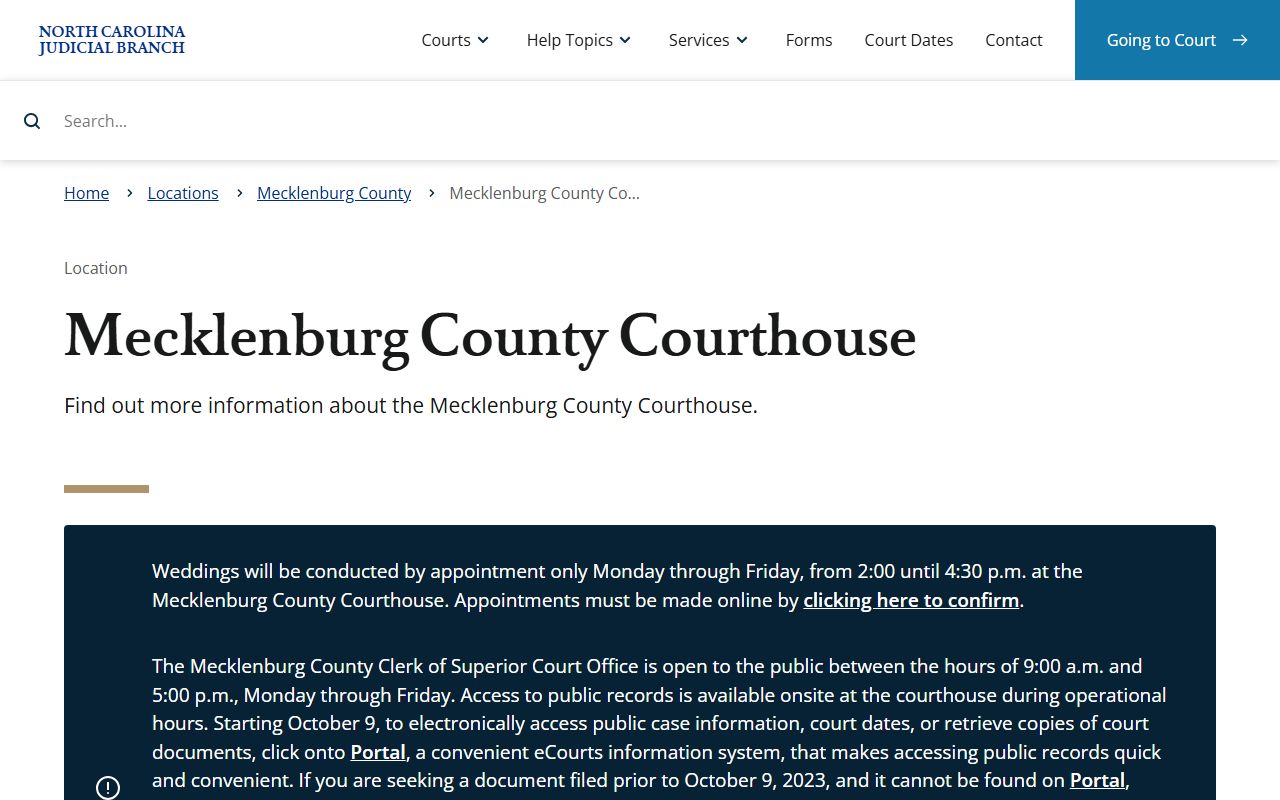
This is the main courthouse that handles all divorce filings for Charlotte and the rest of Mecklenburg County.
Divorce Filing Process in Charlotte
Filing for divorce in Charlotte follows North Carolina state law. You file at the Mecklenburg County Clerk of Superior Court. Each step creates records that become part of the public case file. Under N.C. General Statutes Chapter 50, the process starts with meeting two key requirements: residency and separation.
First, at least one spouse must have lived in North Carolina for six months before filing. This is set by G.S. 50-8. You do not have to be a Charlotte resident for all six months. If you live in Charlotte now and meet the state residency rule, you can file here. Second, you must live separate and apart for one full year before filing for absolute divorce under G.S. 50-6. During that time, at least one spouse must intend the split to be permanent. This one-year separation is the only ground for absolute divorce in the state.
Once you meet both rules, you file a complaint for absolute divorce at the courthouse. The fee is $225. You then serve your spouse with the papers. Service can be done by the Mecklenburg County Sheriff, a private process server, or certified mail with return receipt. Proof of service gets added to the court file. If your spouse agrees, you set a hearing date. The judge enters the final judgment, which dissolves the marriage. That judgment becomes a public record under Chapter 132 of the NC General Statutes.
Note: Claims for property division and alimony must be filed before the divorce judgment is entered in Charlotte, or they are waived for good under G.S. 50-11.
Charlotte Divorce Record Fees
Fees for divorce records in Charlotte follow the standard North Carolina schedule. The Mecklenburg County Clerk of Superior Court sets these rates. Costs can change, so call (704) 686-0400 to confirm before your visit.
Uncertified copies of Charlotte divorce records cost $0.25 per page. Certified copies are $5.00 per document plus copy fees. Exemplified copies run $10.00 per document. If you need staff to search for a case, that costs $2.00 per name. Payment methods include cash, check, money order, and credit cards. A processing fee applies to card payments.
You can also get a divorce verification letter from the NC Vital Records office for divorces from 1958 to the present. The fee is $24 for the first copy and $15 for each extra copy ordered at the same time. Mail requests go to 1903 Mail Service Center, Raleigh, NC 27699-1903. Processing takes about 5 to 7 business days plus mail time. For the full divorce judgment from a Charlotte case, you must go through the Mecklenburg County clerk.
Charlotte Family Court Resources
Mecklenburg County offers several specialized programs that may apply to Charlotte divorce cases. The Family Court handles scheduling and case flow for all family law matters. The Family Financial Settlement Program helps families reach property division agreements outside of litigation. This can save time and reduce costs for Charlotte residents going through a divorce. The clerk mediation program is also available for civil cases that need a neutral third party.
The Mecklenburg County contact directory lists direct lines for each division. Family Court can be reached at (704) 686-0202. Custody Mediation is at (704) 686-0268. The Guardian ad Litem program is at (704) 686-0075. These resources serve all Charlotte divorce cases that involve children or complex property issues.
The county also provides access to historical Charlotte divorce records through the North Carolina State Archives. Records from before 1958 may be stored there rather than at the courthouse. Contact Flannery Fitch at 919-814-7066 for help with pre-court reform records. The Carolina Room at the Charlotte Mecklenburg Library also holds historical documents that may include early divorce and separation records for Charlotte.
You can learn more about the county government services through the Mecklenburg County portal online.
The NC Judicial Branch oversees all court operations including divorce case processing in Charlotte.
Filing for Divorce in Charlotte Pro Se
Some Charlotte residents file for divorce without hiring a lawyer. This is called pro se filing. It works best when both spouses agree and there are no disputes over property or children. The court does not give legal advice, but resources exist to guide you through the process.
The NC Judicial Branch website has all the forms you need. Complaint forms, answer forms, and other required papers are free to download. The Mecklenburg County courthouse also has form packets at the clerk office. If your case involves children, you will need extra forms for custody and child support. The clerk staff can tell you which forms to file for your Charlotte divorce case.
Legal Aid of North Carolina serves Charlotte and all of Mecklenburg County. They offer free legal help to people who qualify based on income. Call their helpline at (866) 219-5262 or visit legalaidnc.org for more details. The North Carolina State Bar also runs a lawyer referral service at 1-800-662-7660 for Charlotte residents who need a family law attorney.
Note: You can include a request to resume your maiden name in the divorce complaint under G.S. 50-12 at no extra filing fee.
Mecklenburg County Divorce Records
Charlotte is in Mecklenburg County. All divorce filings go through the Mecklenburg County Clerk of Superior Court at the courthouse in uptown Charlotte. The county court handles cases for Charlotte and all other towns in the county. For a full list of county resources, fee schedules, and related records, visit our Mecklenburg County page.